Impermanence Studios

What’s your name and where are you based?
I’m Mallory Granata, the artist behind IMPERMANENCE STUDIOS. I am based in New York City.
Can you describe your practice in a few words?
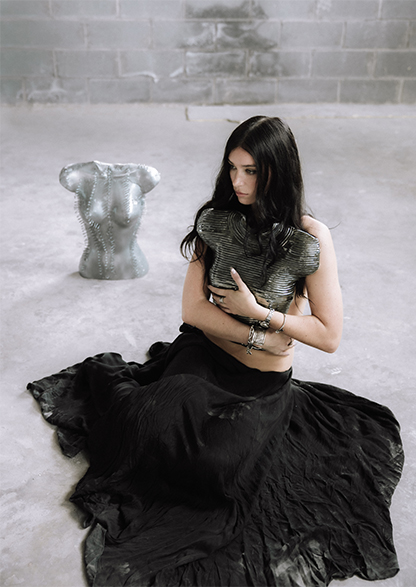
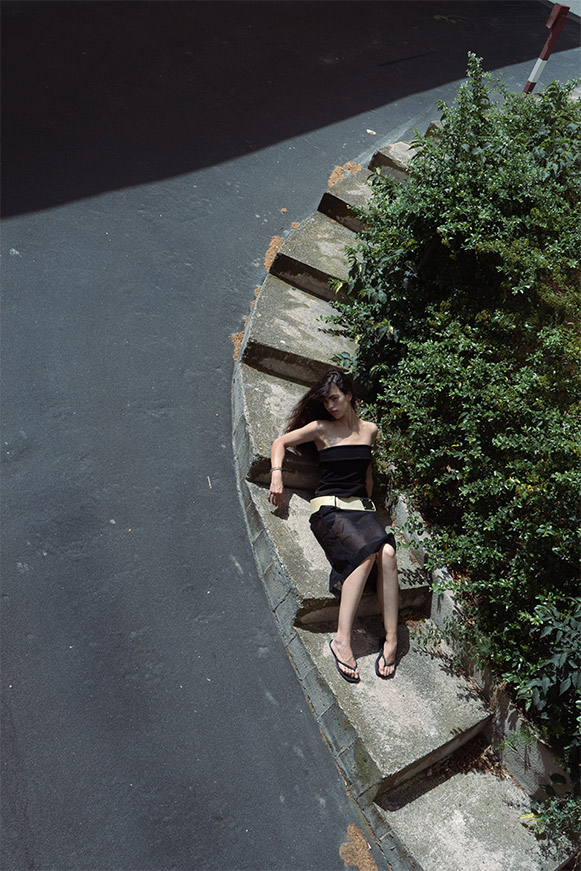
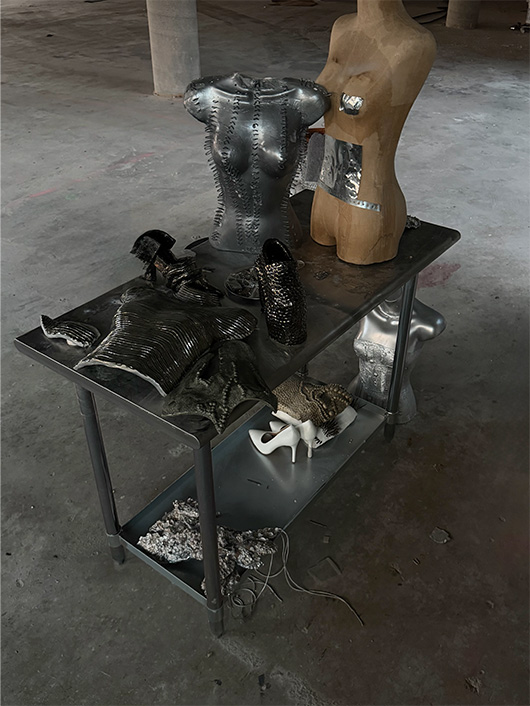
IMPERMANENCE STUDIOS sits at the intersection of fashion and art. Impermanence is the concept that everything we know can slip away from us at any point, and disappear entirely. My atelier explores what survives Impermanence with the examination of fashion history, material experimentation, and archival influence through sculptural and wearable bodies of work.
How did you begin to be interested in fashion, and where did the idea of approaching it as art first come from?
Both Fashion and Art have been part of my identity for as long as I can remember. I made paper dolls when I was three, started a very unofficial “fashion brand” in my fifth-grade sewing class, discovered runway sketching through YouTube in middle school, wearable art in my high school AP class, studied Fashion Marketing at the Parsons School of Design in NYC, made my way to LVMH, and now I’m here with my own atelier.
Otherwise, I became obsessed with McQueen at a young, formative time in my life. His shows made me understand that fashion could create an entire world beyond just clothing.
I knew how to sew, but sewing always felt a little too by-the-book for me. I preferred building things with whatever I could find: cardboard, plaster, magazines, chain, pieces of metal. Once I realized I could treat the body almost like a surface for sculpture, everything opened up.
The studio is called Impermanence. Where does the name come from?
A little over a year ago, I was on top of a mountain in South Africa. It was as if we were sitting above the earth, and there was a huge rock that was engraved with the words, “One of life’s most precious gifts is Time”.
It felt like the culmination of my greatest fear: running out of time. I have always felt this urgency around how I can possibly experience as much of life as possible when nothing is truly predictable. This started my pursuit to survive Impermanence, and to tell that story through what I think defies it: Fashion and Art.
Fashion is especially interesting to me through that lens because nothing is created in isolation. Designers inherit ideas, silhouettes, techniques, and references. I want to pay homage to the pioneers who shaped the way we understand art and fashion today, while also considering how there is a responsibility to invent and inform the archives of tomorrow.
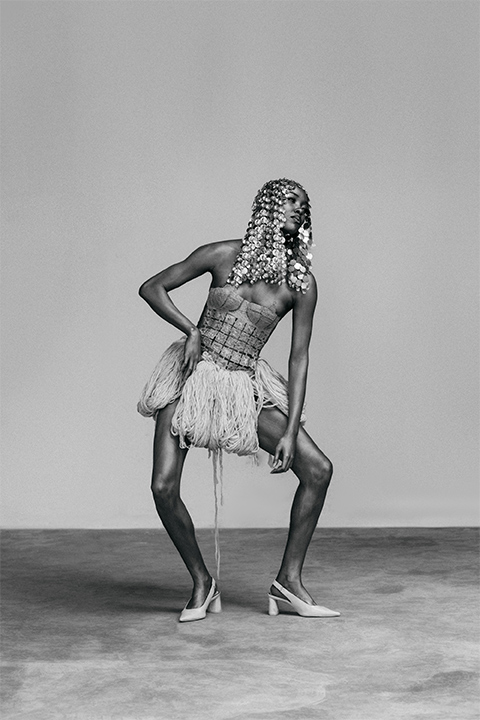
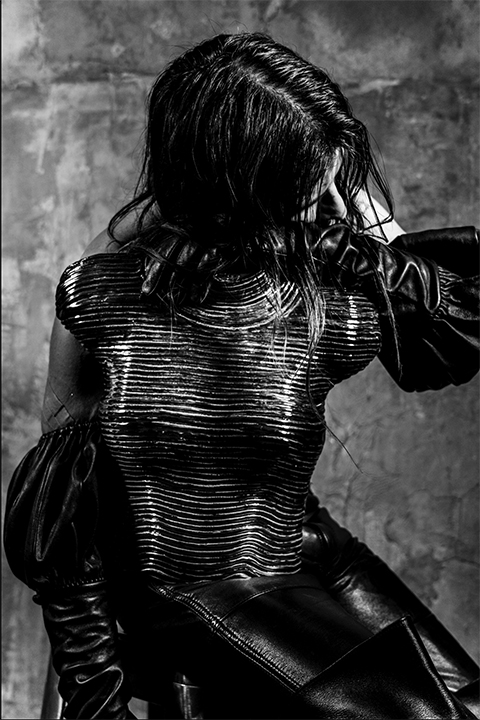
Your first materials came from a childhood beach where you and your mother would collect shells for hours. How did you start seeing those as material, and how far are you willing to push what counts as wearable?
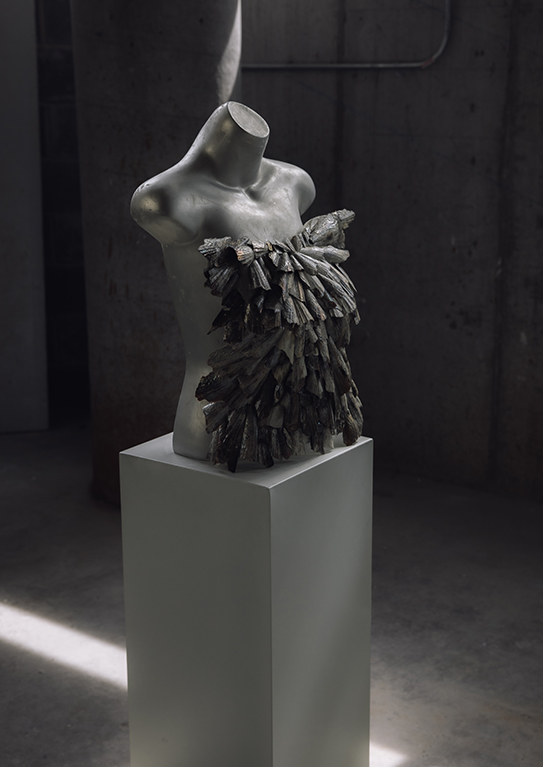
I was already drawn to shells through archives like McQueen’s VOSS, but in my own practice, I wanted materials tied to my own archives that could challenge both me and the viewer, such as knitwear that becomes structured, or porcelain that reads like metal.
My mom and I spent hours collecting shells when I was growing up, so returning to the beach together felt like a natural place to begin.
I also have a pretty loose definition of “wearable.” I think almost anything can become wearable if you’re willing to try. That experimentation is part of what interests me. Someone had to be the first person to decide that shells can belong on a body instead of on a beach. I want to keep pushing that boundary with materials that people might not immediately associate with clothing.
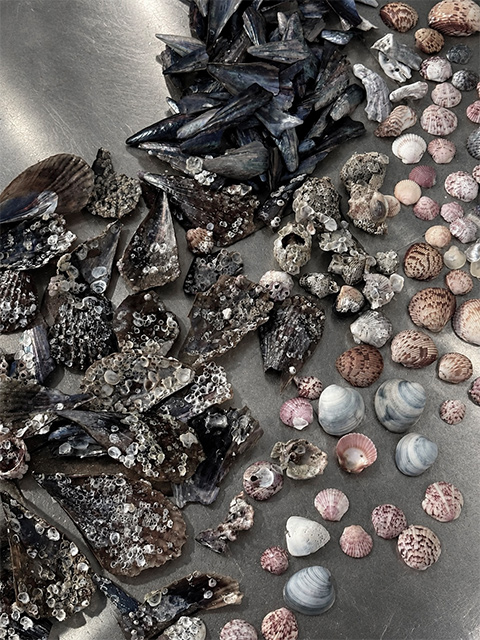
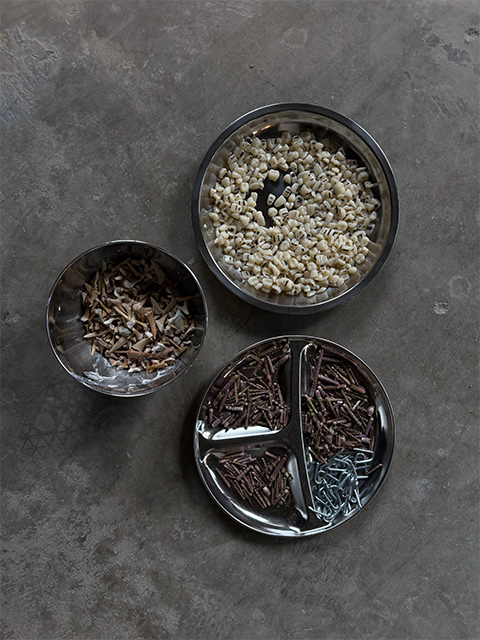
You remade McQueen’s coiled corset, originally constructed in metal, out of clay, and you’re now hand-carving each of the 2,000+ razor clam shells for another piece rather than using real ones. Can you tell us why you want to construct these, and why the harder way?
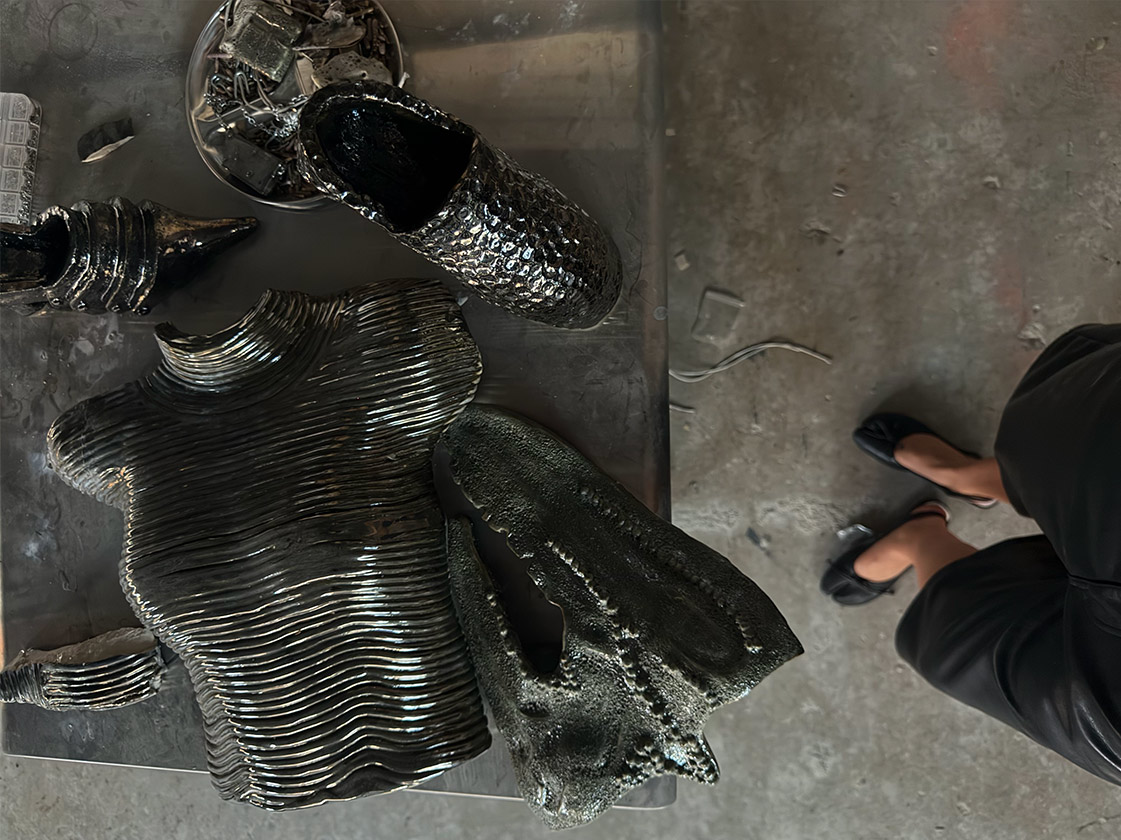
I consider those pieces homages rather than replicas, because reconstructing them lets me study fashion history physically. By confronting the labor, repetition, frustration, and problem-solving behind them, I can tell the story of archive-defining pieces more intimately.
With the McQueen x Shaun Leane coiled corset, I used porcelain to imitate metal. Metal reads as durable and protective; porcelain is fragile and unpredictable. From a distance, you think you understand what you’re looking at, but materially it’s almost the opposite. From a construction perspective, it’s wildly different.
For the Razor clam piece, I could just go collect 2,000+ shells from restaurants and make my life ‘easy’, but no one would expect me to hand carve each shell by hand. So that’s why I’m doing it that way. It becomes absurdly labor-intensive – and that intensity becomes part of the work and the homage.
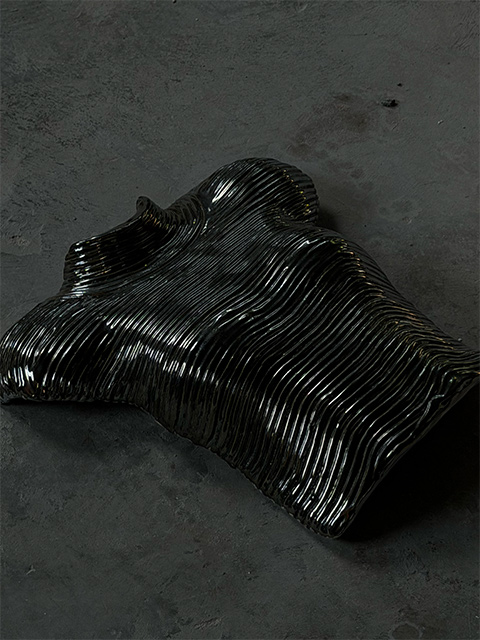
The sea urchin spine corset cracked while you were building it, and you left the cracks and grooves visible. Is allowing these parts to be visible a big part of your pieces?
Definitely, especially when the imperfection tells you something about the object’s existence. When you look at artifacts in museums, their damage is often part of what makes them powerful. A crack or worn surface becomes evidence that the object actually survived something.
Nature works the same way for me. Shells, stones, fossils – they’re essentially the earth’s archives. Their surfaces record pressure, erosion, growth, time.
With that corset, I wanted it to feel like something that had been pulled from the bottom of the ocean after hundreds of years. So when cracks appeared naturally during the drying process, repairing them would have actually removed part of the story
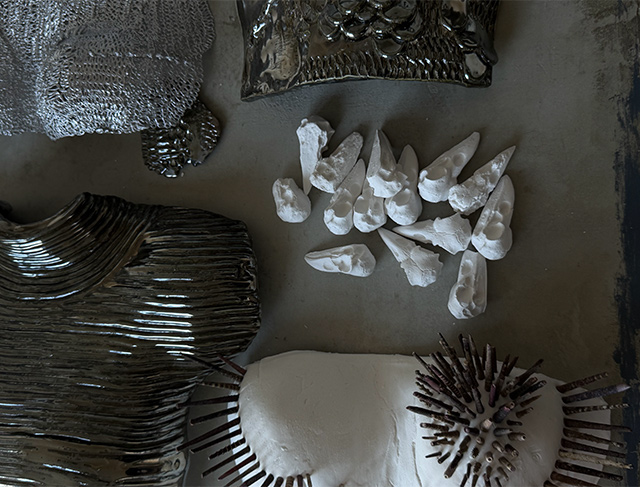
This attention to detail and level of craftsmanship in your work contrasts with an industry obsessed with speed. Is that deliberate?
Very much so. We live in a culture where everyone feels pressure to make the next thing immediately – before someone else has the same idea, before the algorithm moves on, before the trend disappears.
That’s part of why haute couture and traditional ateliers are so compelling to me, it is work born from time, expertise, and meticulous craft. It never prioritizes chasing something so quickly that it sacrifices the rest.
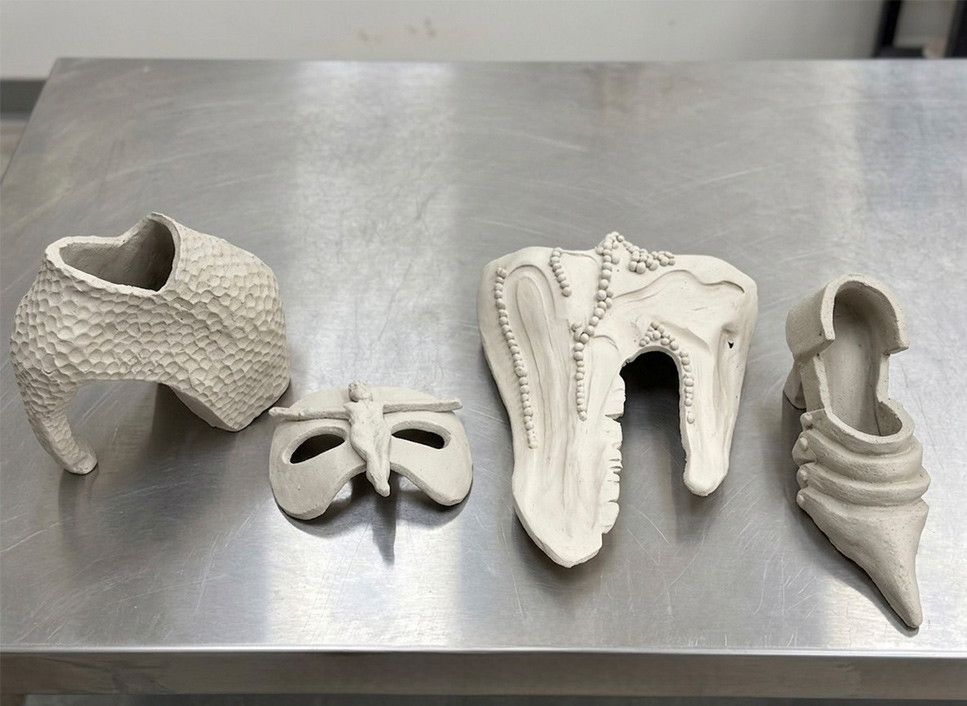
Outside of your practice, you design experiences at LVMH. What do you think one gives the other?
Working within LVMH completely changed the way I understand craftsmanship.
I’ve seen how the value of an object often comes from everything you don’t immediately see – I’ve learned the importance of heritage, storytelling, craft, savoir faire.
Savoir-faire is the deep mastery of artisanal craftsmanship, and a specialized expertise that gives an object its true value. It represents rare skills, strict precision, and artistic heritage.
At it’s core is valuing human creation. I personally believe that this is more important than ever right now, and I’m proud to have witnessed this myself and taken it into my own practice.
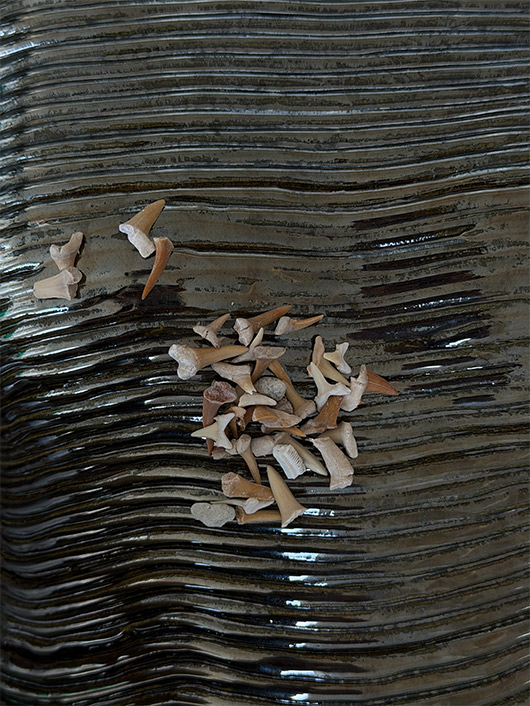
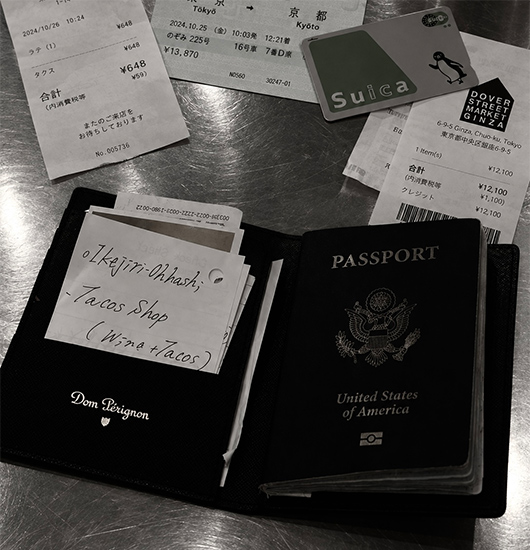
You travel a lot, visiting the northern tip of Norway, Alaska, Japan, Antwerp, and you collect from everywhere, down to recommendations written on scraps of paper kept in your passport holder. What are you collecting for?
Travel is truly a massive part of my life. I’m not one to journal, but after a trip I’ll try to make collages of little memorabilia I’ve collected along the way. It’s the small memories, the tickets to a museum or the flight that got me there, that makes the memory feel really complete.
I feel so motivated to experience all that life has to offer, because every travel inspires me in ways beyond my own understanding. There is so much to learn about culture and life that can only be achieved by travel. It constantly reminds me how little I know – which is probably why I’m so addicted to it.
You’ve been thinking about estate sales, where strangers buy a lifetime of someone’s objects with no understanding of them or why any of it was kept. Can you tell us more about that idea?
In estate sales and thrift stores, I’ve discovered old family photos, or closets that show such distinct personalities. It makes me wonder about who they were, and I think back to Impermanence. If you thought about everything that you’ve collected in your lifetime, and then if it was put on display to strangers to sift through – what would that tell them about you, or how you spent your time. What you cared about.
If people sifted through my passport holder of old tickets and receipts, it’d probably mean nothing, but it’s some of the things that I actually hold most dearly to myself.
I think it’s sad to think an entire lifetime of memories can be put up for sale. It’s sobering and humbling to think of it that way, but there’s a real truth to it, and in part what I want to challenge with my work.
What’s currently inspiring you outside of your work?
Travels, history, art, love, friendship. I have been calling myself a life optimist recently, and I feel proud of that because it wasn’t always the case. I’ve gotten to a point where I am just so grateful to create and to live and to love. Inspiration is all around you if you look for it. I think once you become genuinely curious about being alive, it becomes very difficult to run out of inspiration.
Where can people find you?
You can find me on Instagram and TikTok at @impermanencestudios. There’s quite a bit happening behind the scenes at the moment—hopefully, you’ll be seeing more of me soon.