Jean Oltra
What’s your name and where are you based?
My name is Jean Oltra, I am based in Paris.
Can you describe your practice in a few words?
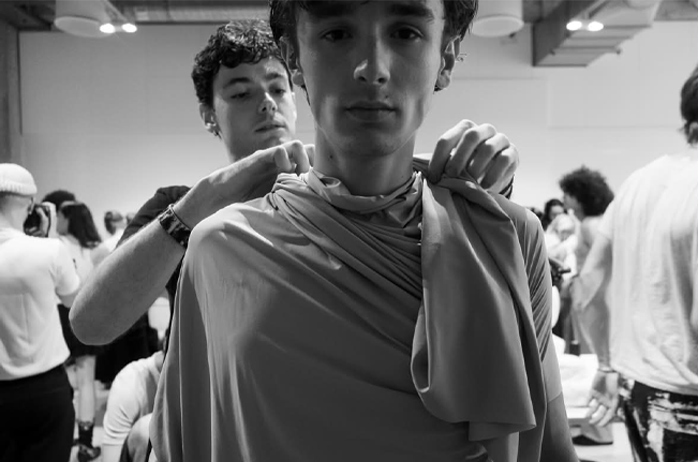
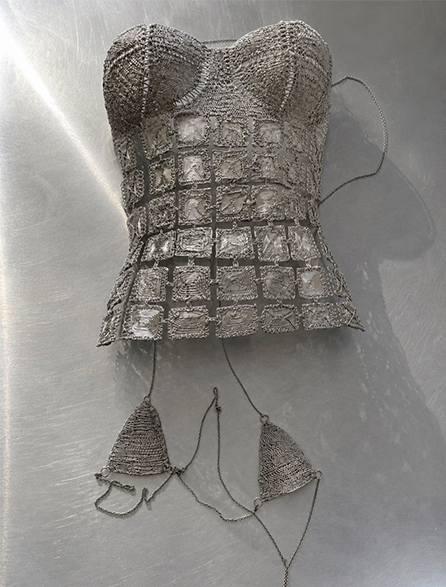
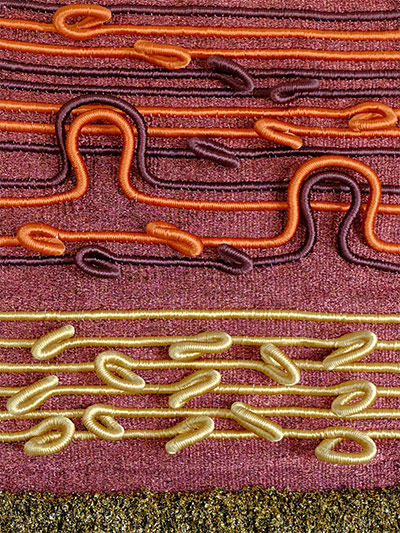
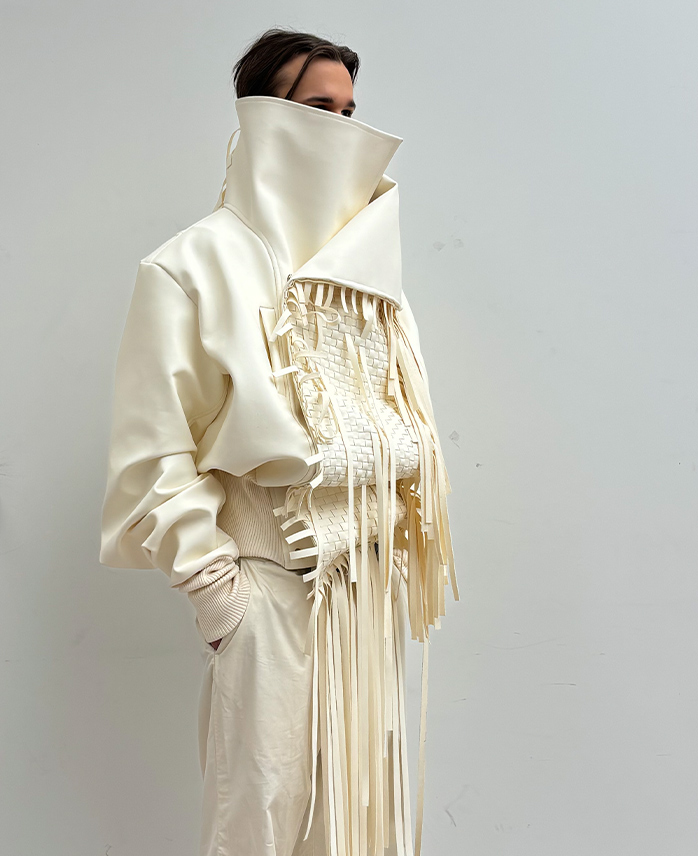
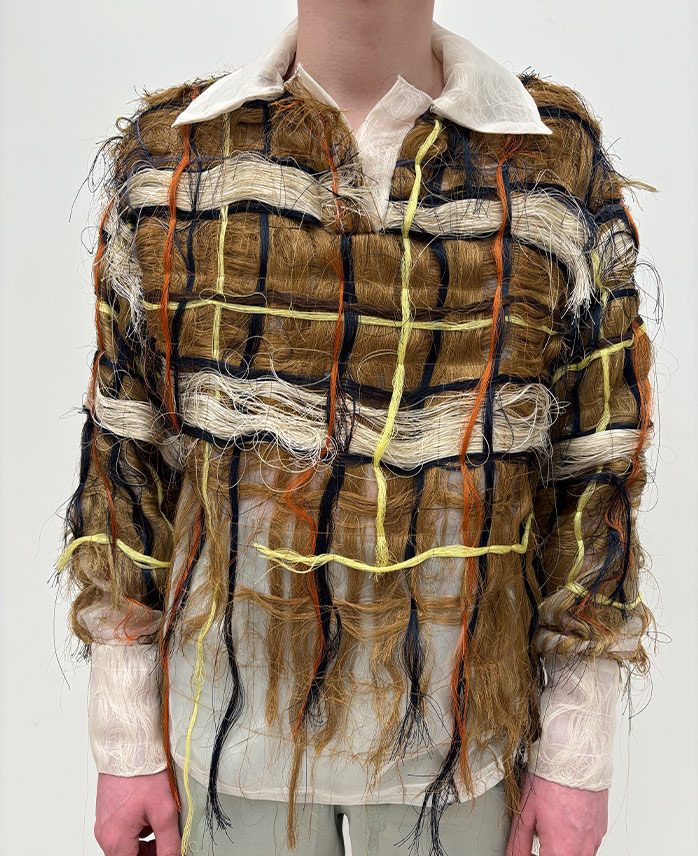
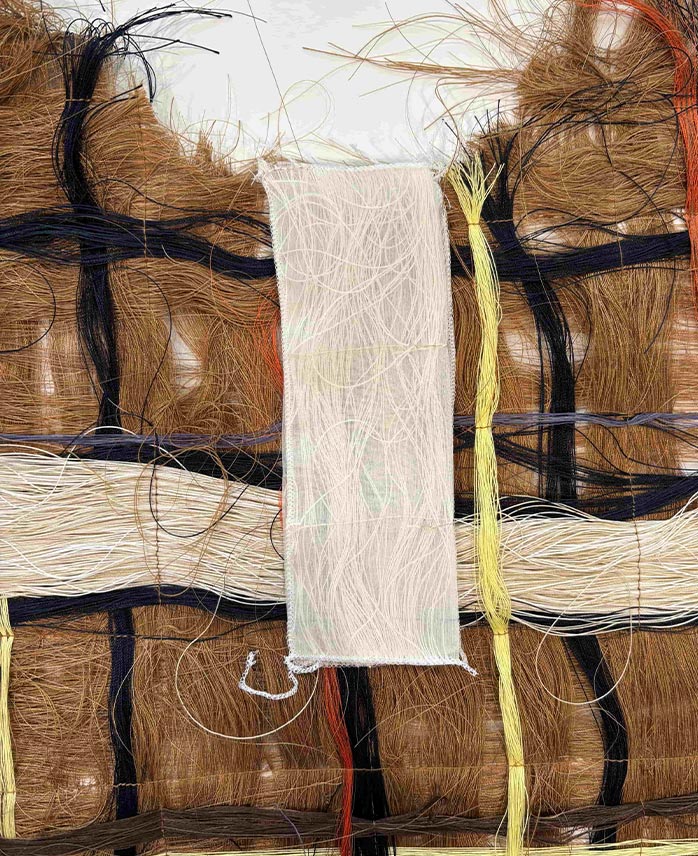
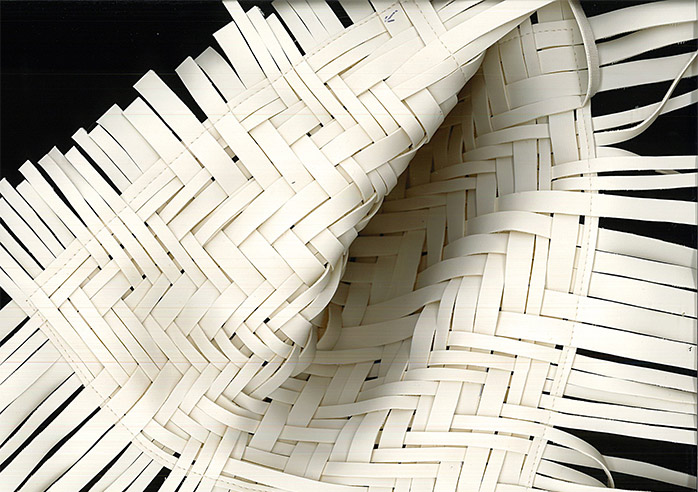
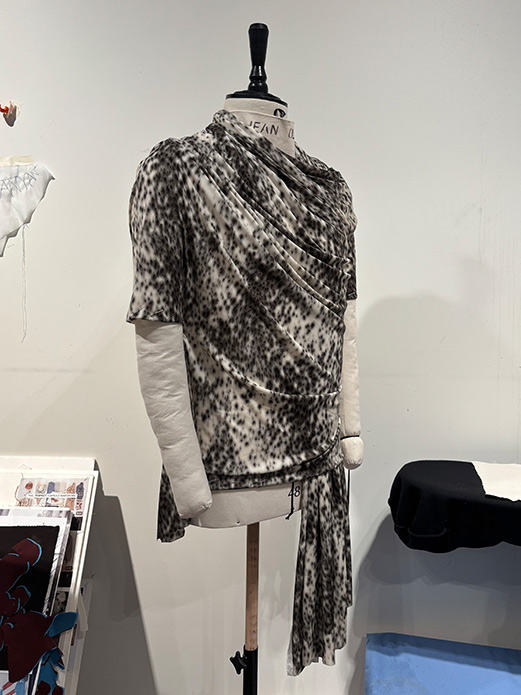
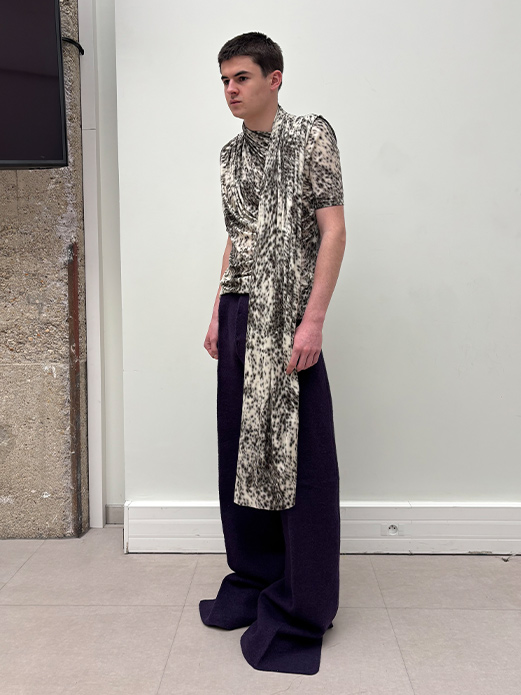
I like I explore archetypal garments and transform them into something more dramatic and glamorous. I approach silhouette construction as if I were building a character. I compare this process to a Cluedo game, not in the sense of categorising people, but in the idea of tracing someone back through clues, assembling fragments to understand a presence that is not immediately legible. To do so, I work through fabric manipulation techniques such as hand weaving, leather treatments, and a combination of tailoring and draping. I am interested in how material choices can shift perception and build narrative within a garment. I also like to develop bags and accessories, as they complete and “seal” the character I am constructing, extending the narrative beyond clothing alone.
You grew up surrounded by art and culture through your Spanish and Portuguese background and how those influences became part of your creative life. Looking back, what are some of your earliest memories of making or of becoming aware that you were interested in creating?
My grandma always painted and had all her material in the room we stayed at with my siblings in the summer and I guess from the earliest age we had a drawing book in our hand to have us do something. I specifically remember me and my brother had a spiderman drawing book each where we would draw our legos going to war at eachother on huge battlefields. I think at that point my dream job was ‘toy inventor’ and to own a shop selling those toys.
You had chosen to carry your mother’s surname, a deeply personal and emblematic decision. Beyond family, what does this name represent to you today, both as a person and as a designer?
I think choosing my mother’s surname was a way of embracing a part of my identity that felt deeply meaningful to me. It reflects not only my family history but also the values I grew up with: creativity, sensitivity, and a strong appreciation for making things by hand. It felt like the most authentic way to introduce myself, both personally and professionally. My designs are often rooted in personal memories, atmospheres, and cultural references, drawing from my heritage while looking beyond it.
You often speak about atmosphere and memory rather than trends or garments. Have you always been sensitive to environments and emotions, or is this something you recognized about yourself through fashion?
I think I’ve always been sensitive to environments, even before I realised it through fashion. I feel most creative when I’m moving through a space, picking up visual and emotional cues. Whether I’m walking down a street, dancing at a party, or visiting a museum, I instinctively imagine how people might feel, interact, or move within that environment, even when the space is empty. I’m fascinated by the atmosphere a place carries and the stories it suggests. It’s almost like world-building: I project myself into these imagined situations and pay attention to my own emotions and state of mind. In a way, it’s a form of daydreaming, but it’s also how I begin to understand what I want to express. Fashion became the medium through which I could translate these imagined worlds into something tangible, so I don’t think this sensitivity came from fashion, it simply found its language through it.
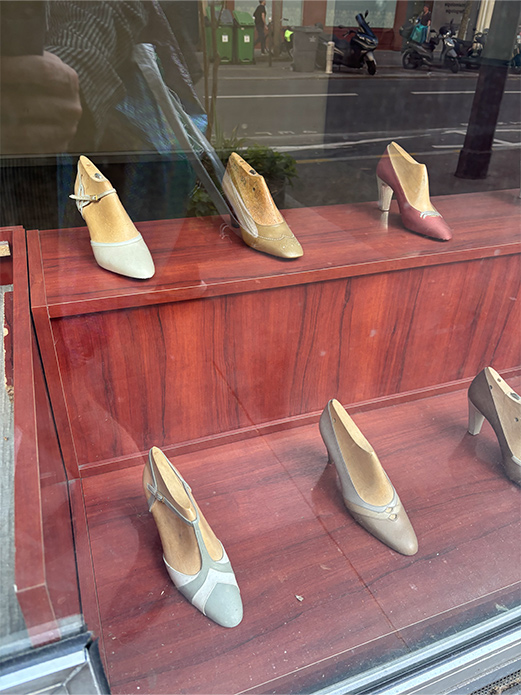
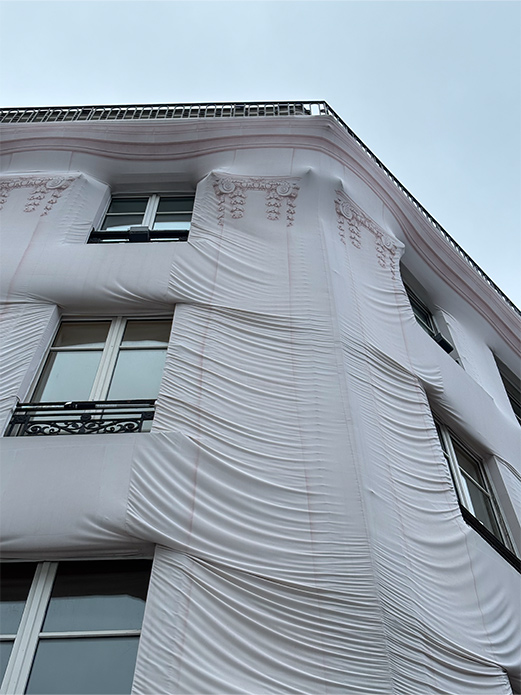
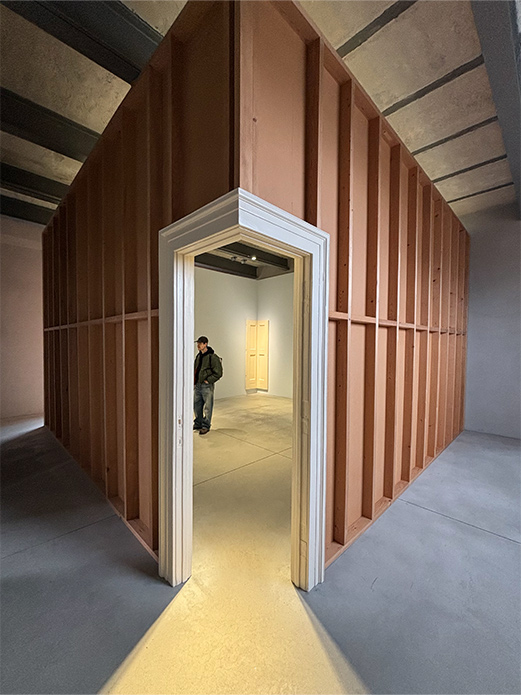
Cinema and installation art are central to your research; you’re drawn to carefully constructed universes where every detail builds its own atmosphere. What is it about these that pulls you in, and which ones have marked you most?
I think what draws me in most is the level of intention behind these worlds. I have a huge appreciation for work that feels effortless, even though every detail has been carefully considered. The best films and installations create an atmosphere so coherent that you stop noticing the individual elements and simply experience the world they’ve built. I find that incredibly inspiring. One installation that has stayed with me is Stone Speakers by Julian Charrière, which I saw at the Palais de Tokyo. It transformed geological depths into something almost alive through sound, light, and space. Rather than simply presenting an idea, it made me physically experience it. I left feeling as though I had briefly entered another reality, and that’s something I constantly search for in my own work. I want my garments to evoke a similar feeling—to immerse people in an atmosphere rather than simply be looked at.
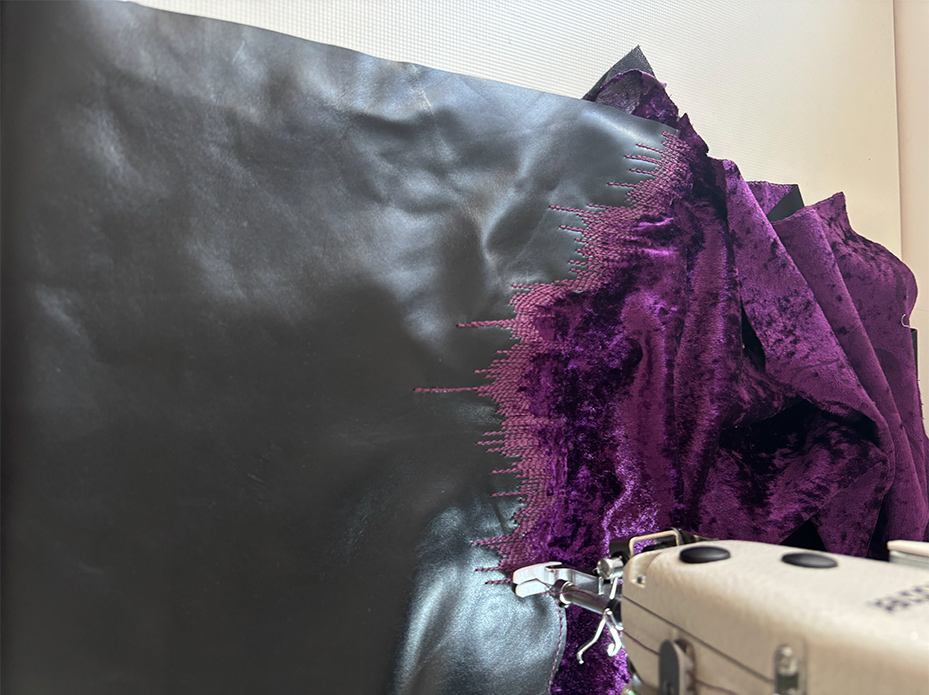
Your graduate collection is rooted in David Lynch’s Blue Velvet and its two central figures: Jeffrey Beaumont, the well-behaved college boy, and Dorothy Vallens, caught in a troubled nocturnal world. What drew you to this film and why did it feel right for this moment?
I first saw *Blue Velvet* about two years ago during a retrospective in the Quartier Latin organised as a tribute to David Lynch after his passing. I went with some friends without knowing anything about the film, and I think that made the experience even more impactful. I wasn’t watching it with the intention of finding inspiration, it came much later. At the beginning of my graduate collection, I was interested in the idea of the Western nuclear family and how it has shaped our perception of the “ideal” way to live, behave, and even dress, largely through decades of American cultural influence. It was a subject I found fascinating, but also incredibly difficult to translate into garments. Looking back at Blue Velvet, I realised it captured exactly that tension. On the surface, it presents the image of the perfect suburban America, but beneath it lies something much darker, stranger, and deeply unsettling. Jeffrey Beaumont’s curiosity gradually draws him into Dorothy Vallens’ world, revealing the fragility of this idealized reality. I was fascinated by that contrast between innocence and transgression, order and desire. It became the perfect narrative through which I could explore these ideas visually, using clothing to suggest the collision of two worlds rather than simply illustrating the film itself.
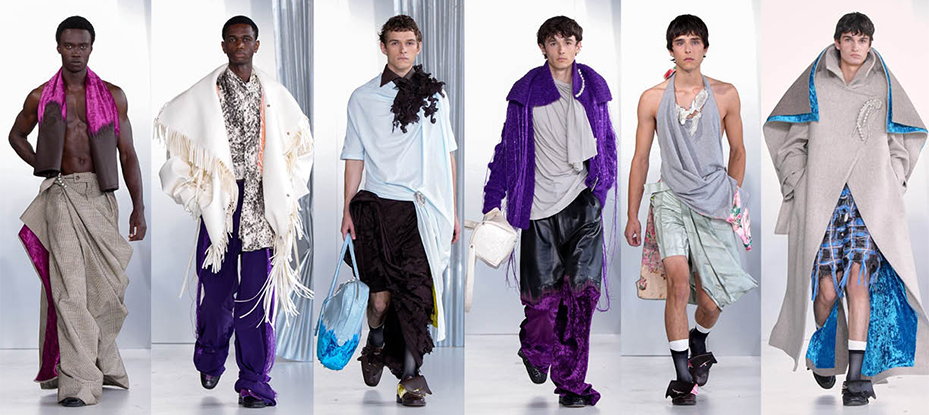
Rather than presenting these two worlds as opposites, the collection explores how they gradually collapse into one another. What is it about duality, where boundaries of opposition dissolve into one, that fascinates you?
I don’t think people, places, or even clothes are ever completely one thing. What fascinates me is the moment when something begins to contradict itself. A familiar place suddenly feels unsettling, a gesture that seems reassuring becomes ambiguous, or a garment carries two identities at once.I think that’s why I’m drawn to stories like Blue Velvet. The film doesn’t simply oppose innocence and darkness, it shows how one exists because of the other. The boundary between them gradually disappears, making both worlds feel more believable.
In my work, I’m interested in creating that same sense of ambiguity. I don’t want garments to communicate a single, fixed idea. I like when they hold different readings at the same time, when they feel suspended between protection and exposure, elegance and unease, familiarity and estrangement. That tension is where I find the most interesting emotions.
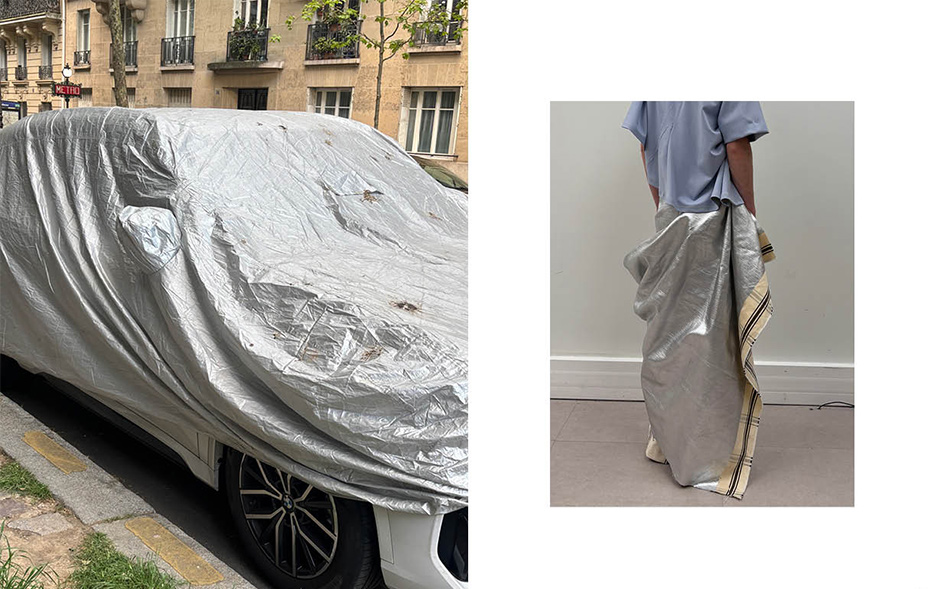
Your collection text says “desire and fear become indistinguishable.” Can you describe a moment in your own life when you couldn’t tell them apart?
I think one moment I can relate to that feeling is something very simple: when you catch someone’s gaze and it lasts a little too long. In that instant, you are never fully sure of what is happening. There is attraction, but also uncertainty, self-awareness, and a slight sense of exposure. What I find interesting is that the feeling is not clearly readable in the moment. You cannot separate what comes from desire and what comes from hesitation or fear of being perceived. It creates a kind of internal confusion where everything is heightened, but nothing is fully defined. I think that’s what I was referring to in the collection text: those moments where emotions are so immediate and physical that they stop being categorised. They exist as a single sensation rather than opposing forces.
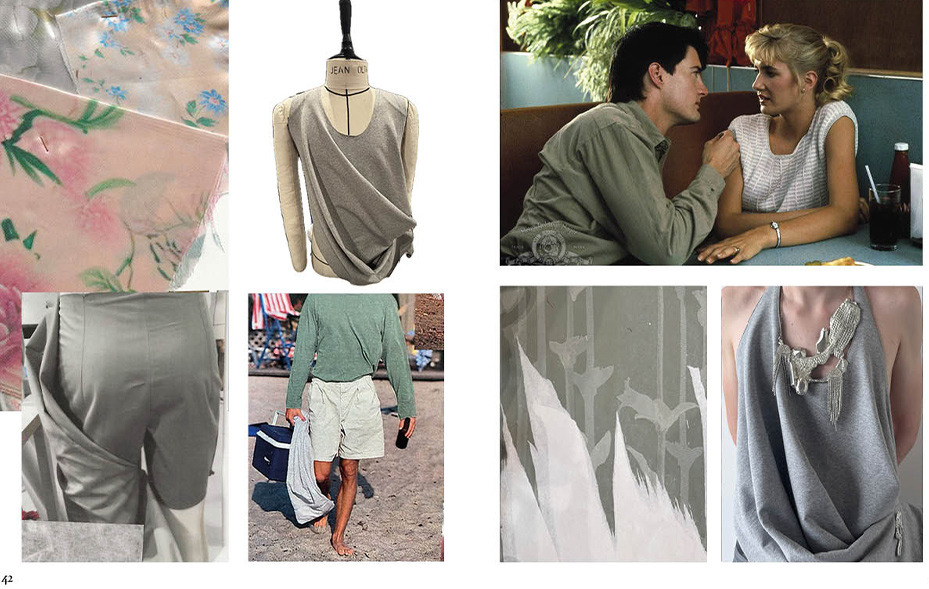
You’ve worked in embroidery at Maison Margiela and on collection development at De Pino. What did those experiences teach you about craftsmanship and building a vision?
It taught me a great deal, both technically and personally. First of all, I received a lot of support from my peers and mentors, which I am deeply grateful for. It gave me confidence in my abilities and a sense of legitimacy in what I am doing, not that one needs to start designing but still, it felt reassuring. Beyond that, these experiences taught me the importance of precision, patience, and collaboration in the making of a collection. At Maison Margiela, working in embroidery allowed me to understand craftsmanship at a very detailed and intimate level, where every gesture matters. At De Pino, I was able to engage more broadly with the development of a collection, from concept to execution, and understand how a creative vision is constructed collectively across different stages. Together, these experiences helped me connect my academic work to the reality of the industry.
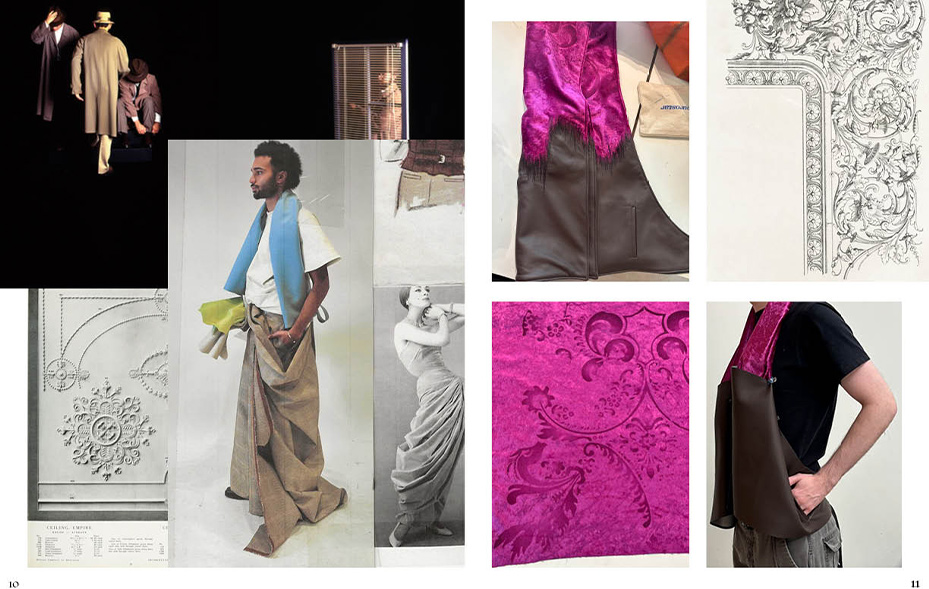
You recently won a Louis Vuitton competition, which leads to an internship at the menswear studio this September. What are you hoping to learn or explore in this next chapter?
The scale of resources and savoir-faire at Louis Vuitton is something I am aware of, and I see this internship as a unique opportunity to learn within an environment where everything from materials to execution can be pushed to a very high level. More than anything, I am excited to observe and understand how a collection is developed within such a structured and demanding studio, and how ideas evolve through collaboration with highly experienced teams. I hope to work on my own design practice by being exposed to that level of precision, and by learning how creative vision is translated into finished garments at this scale. I am also very excited to join the team itself. From what I have seen and heard, it feels like an inspiring and generous environment, and I am looking forward growing within it.
Where can people find you?
People can find me and my work mainly on Instagram, on my account @jeanoltra, where I share my projects and creative explorations.I also like to collaborate with stylists and photographers, most recently on the shoot for Theodora’s latest music video. At the moment, I do not have a physical space or exhibition to present my work, but I am very open to future collaborations and opportunities in that direction.