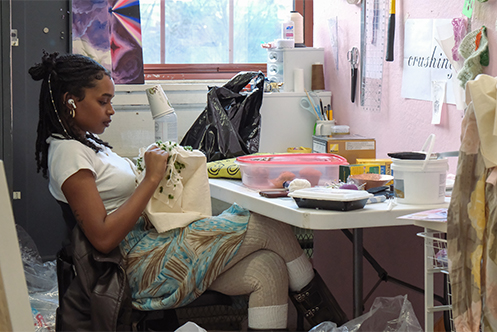
Rania Abdalla Kadafour
What’s your name and where are you from/based?
My name is Rania Abdalla Kadafour and I’m a Sudanese artist born in the US, raised in Qatar, and currently based in Boston.
Can you describe your practice in a few words?
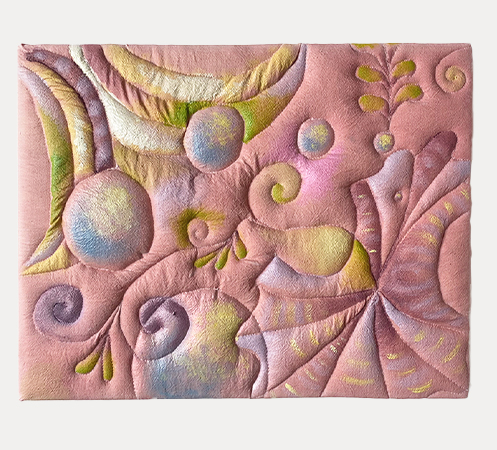
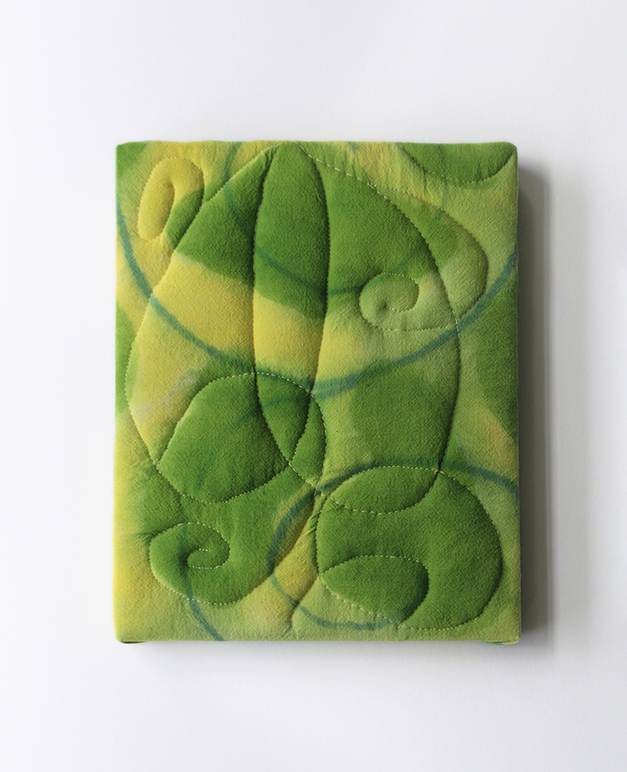
My current work exists at the intersection of quilting, low relief sculpture, and image-making rooted in a background in painting.
You started with painting, what first drew you to working with textiles and stitching?
I started painting seriously around the age of 13, but I had been surrounded by textiles since I could remember. One of my first memories is my mother’s friend showing me how to sew a heart using a sewing machine. Textiles & needlework were also things that allowed me to bond with my late grandmother, who was an accomplished artist, beyond our language barrier. Fiber arts were a beautiful part of my upbringing as a little girl, and I didn’t realize I could combine them with my painting practice until my second year of university when I discovered we had a fibers concentration I could study under.
You’ve described your work as rooted in tenderness; how do you approach emotion as a material in itself?
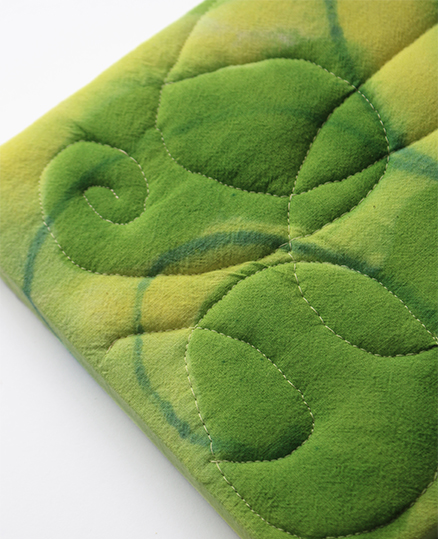
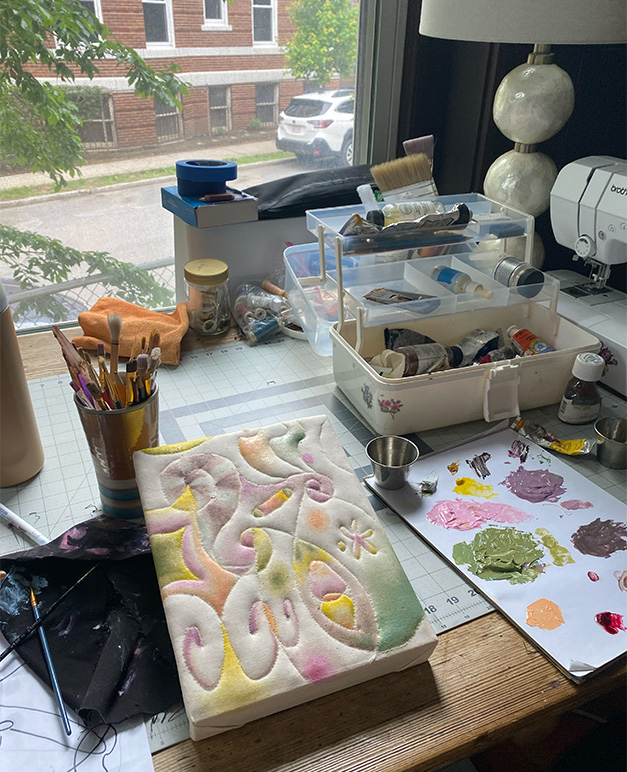
I actually mostly approach emotion in an illustrative or painterly way, depicting it with line & color. I would say the material part of understanding emotion is in the process. It’s in every stitch, every snip, every minute I spend dyeing cloth. I need to process emotion through my hands, engaging them in a delicate labor. The mental stimulation & problem solving that I experience while investigating the material bounds of quilting provide a kind of mental escape for me that is deeply soothing.
Can you talk about what “automatic drawing” means to you, and how you started exploring it in your work?
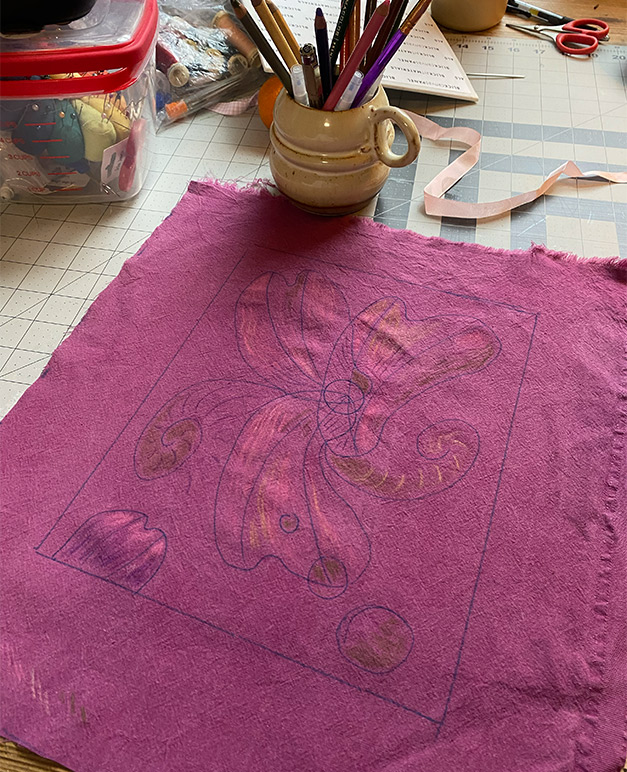
My love for automatic drawing comes from my interest in the surrealist art movement, which I am very inspired by. I am deeply curious about artists who allow invisible forces to move their pen, such as Hilma af Klint or Wassily Kandinsky. I also grew up in a very religious family, but I’ve always rejected organized religion. However, I still believe in a spiritual realm that I am still exploring and understanding. I know that humans have always been able to access this realm through art. I’ve never been one to display literal and explanatory images in my work. I much prefer to let my intuition guide my pen, and to decode my images in the weeks, months, or even years that come after. I’ve learned a lot about myself and the world this way.
You mention that your needlework and braiding come from the women in your life, is there a memory or moment that continues to inspire your work?
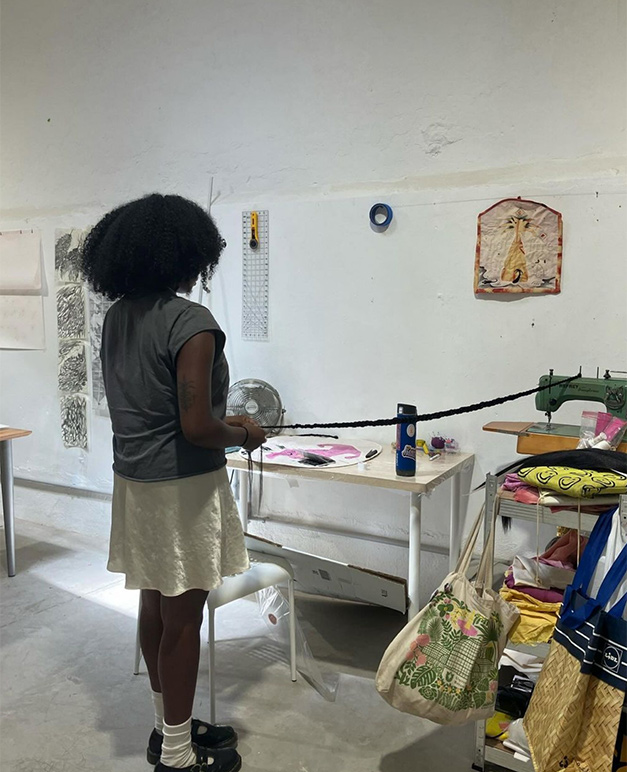
Yes, there are so many. I’ve always believed that working with hair, especially Afro-textured hair is one of the first and most intimate ways we learn to work with fibers. When I was a little girl, I always wore my hair braided and there was a weekly ritual attached to this process by numerous female caretakers, one of them being my nanny who also taught me how to sew. When I was about 12, I began wearing my hair out, which was very challenging at first. Through this experience, I learned to work with a fiber (hair) that is very delicate, yet coarse, requiring a lot of care and attention. It gave me agile hand skills that make working with textiles feel like second nature. There are so many stories I can tell about this experience that I probably can’t fit into this interview.
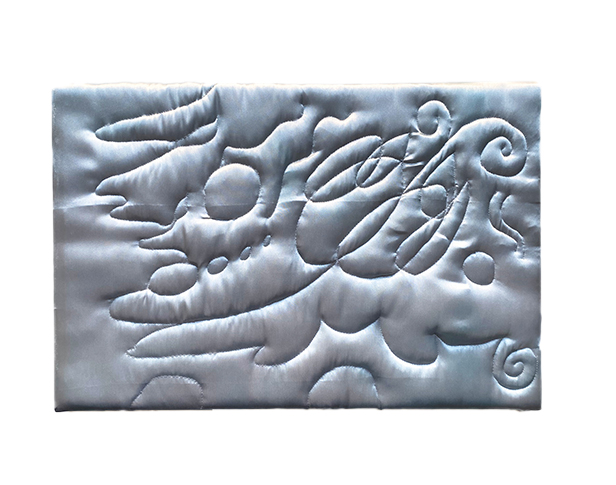
As someone shaped by a third culture experience, does your work try to preserve something you feel could otherwise be lost to time, distance, or assimilation?
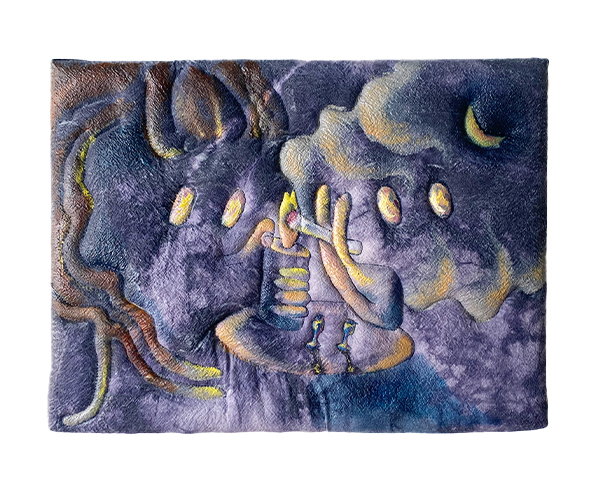
I am always trying to capture small, yet special, fleeting moments in my life, but I also have come to accept that loss of culture is a part of migration that is inevitable. I try not to see it as a “bad thing,” and rather as means of forming a new identity that exists outside of nationality. The small moments I capture aren’t always experiences that are obviously related to culture and migration, but I often realize they are later while observing my past work. An example of this is in the work that I made during my second relationship that I thought, at the time, was solely about romantic love. Later, I realized that I made that work because our relationship felt like a home to me. During the pandemic, we both moved to the US on our own from Arabic speaking countries, which was so hard. Finding some to share this experience with made me feel like I could hold on to that feeling of home, no matter where I was.
There’s a strong sense of rhythm and movement in your stitched lines, do you ever think of your process as choreography or something else?
I feel like the sense of rhythm in my work goes back to the automatic drawing. I let my eyes and my mind move my pen to whichever beat is playing in my mind. I don’t actively try to create a choreography to this process, I just try to let it guide me. I do feel like my all-over compositions mimic the many layers of music in a song, taking up auditory/visual space. I have a deep love for music and I’m always listening to it while I work.
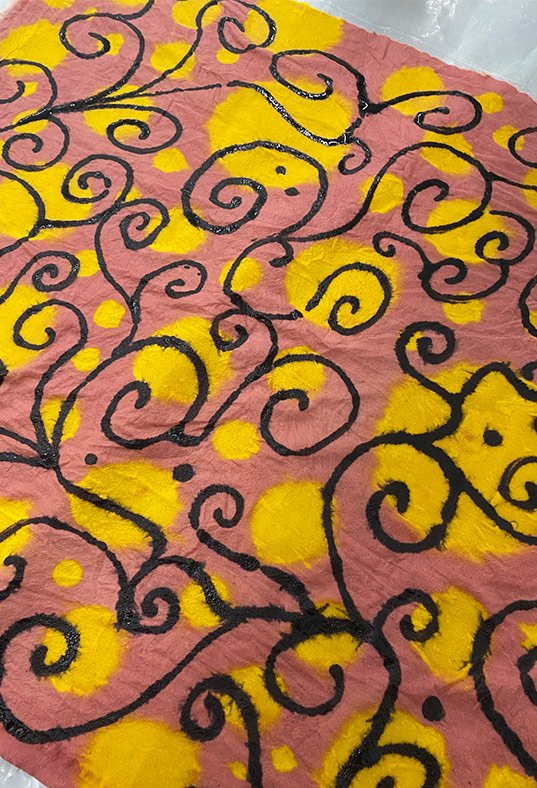
Do certain fabrics you work with carry emotional weight for you?
Honestly, not really. I see cloth more as an opportunity to play with color, texture, and pattern. I hand dye almost all of the cloth that I work with, usually with natural dyes. I think if anything, the cloth holds the weight of the labor and time I spend dyeing and curating it, making it feel more precious.
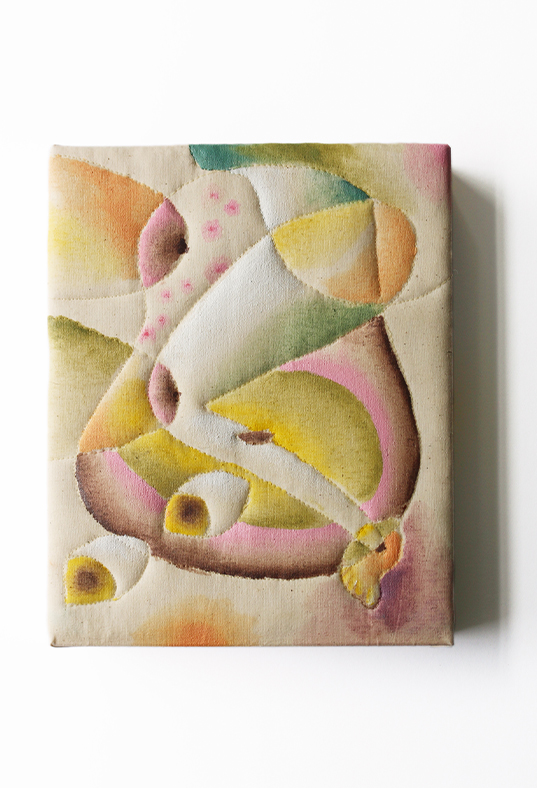
Where can people find you?
Online, you can find me on instagram (@raniakadafour) or on my website (www.raniakadafour.net). I don’t have any upcoming exhibitions at the moment, but I am in the process of finding a gallery that would present my first solo exhibition of my body of soft relief work.