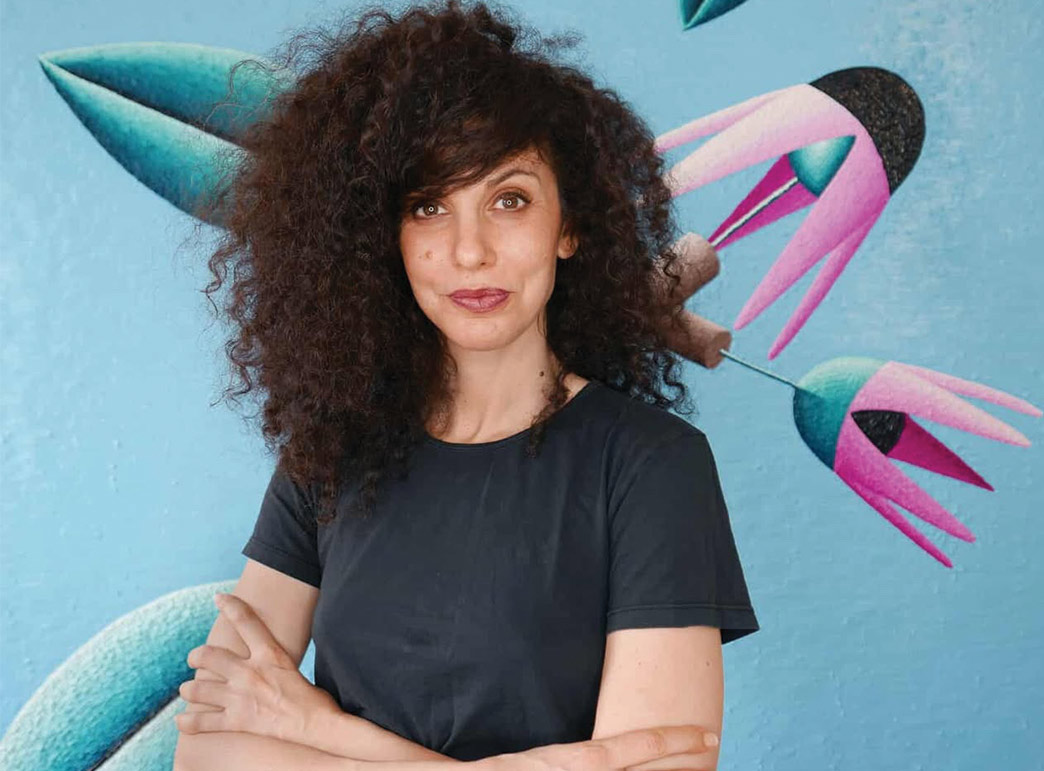
Nadia Nejma Ayari
What’s your name and where are you from/based?
I’m Nadia Nejma Ayari- I grew up in Tunis and am now based in Brooklyn.
Can you describe your practice in a few words?
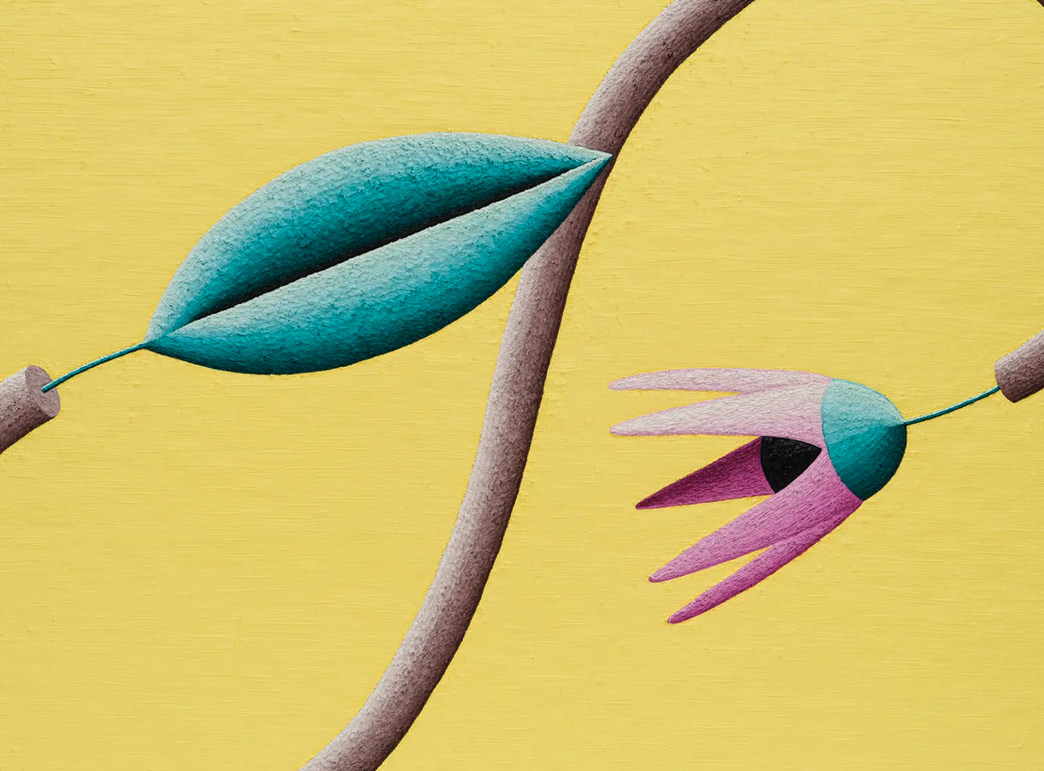
I make paintings and sculptures that employ a set of floral forms to describe aspects of our Anthropocene condition.
You grew up in Tunis and moved to the US, where you first studied art history before going on to paint. How did your curiosity for creating begin?
In the prime of my teenage years, I liked painting with gouache and making pencil drawings. That teetered off during my last couple years of high school cause the workload of sitting the Tunisian national baccalaureate exam in sciences didn’t allow for much else
I got curious about painting and drawing again at the end of my freshman year at an American college; it had become clear that I wasn’t going to stay on the pre-med track and so the course catalog became wide open to me. I signed up for a drawing for non-majors class- the rest is history as they say.
Around 2016 the fig became a central form of yours. What did the fig hold for you, and how did it give way to the flower?
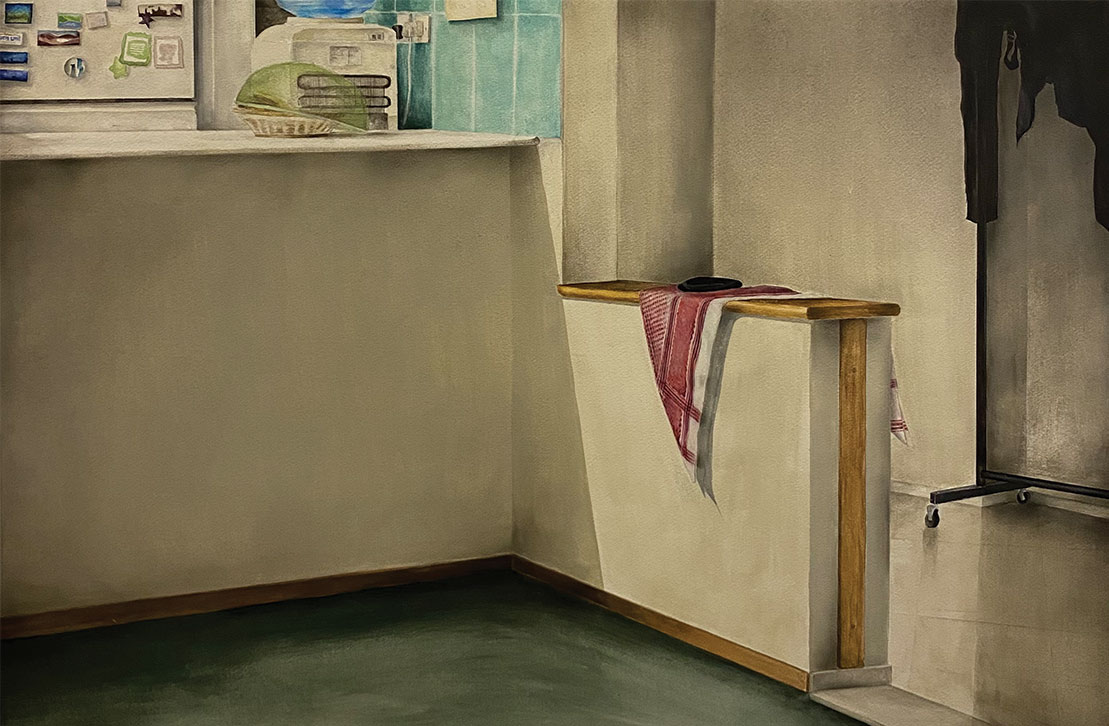
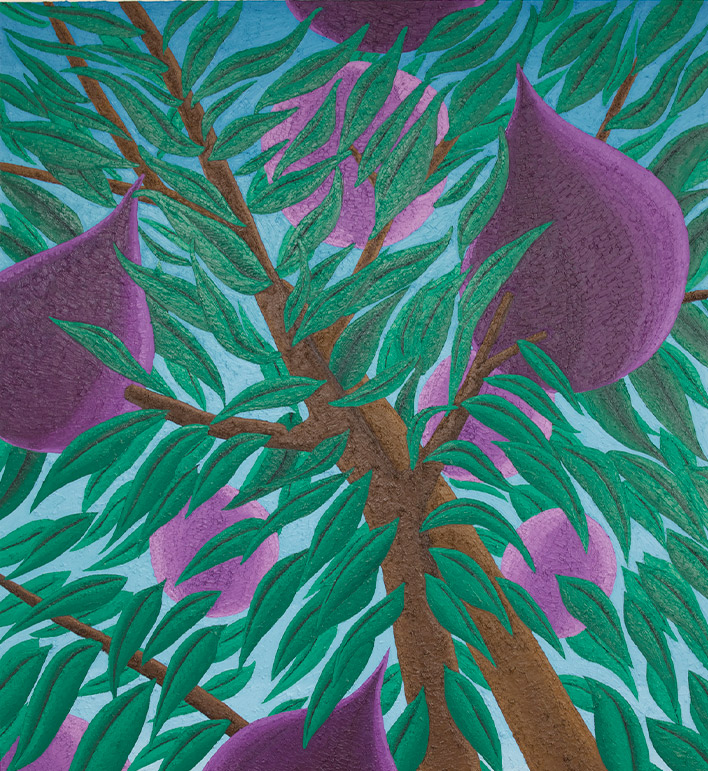
The fig in many ways was a stand in for ‘home.’ It first appeared in a painting called Balcony (2011) that I made in New York City as the Tunisian revolution was taking place. When I started it, it was about the trees in the garden of the house I grew up in. By the time I finished it, the revolution had brought down the old regime and so the painting had gained potent valences. While the symbolism of the fig was crucial to me choosing it as a central character, I also just loved its rounded shape and really enjoyed mixing and placing the varying shades of purple to convey its bulbousness. After working with the fruit for a few years, I felt like removing it would push the work’s narrative. This led to a series with just leaves and branches. A couple years after that, I reached for the flower.
Your flowers, leaves and branches have now been present in your work for years, and you call them protagonists. How do you think about them?
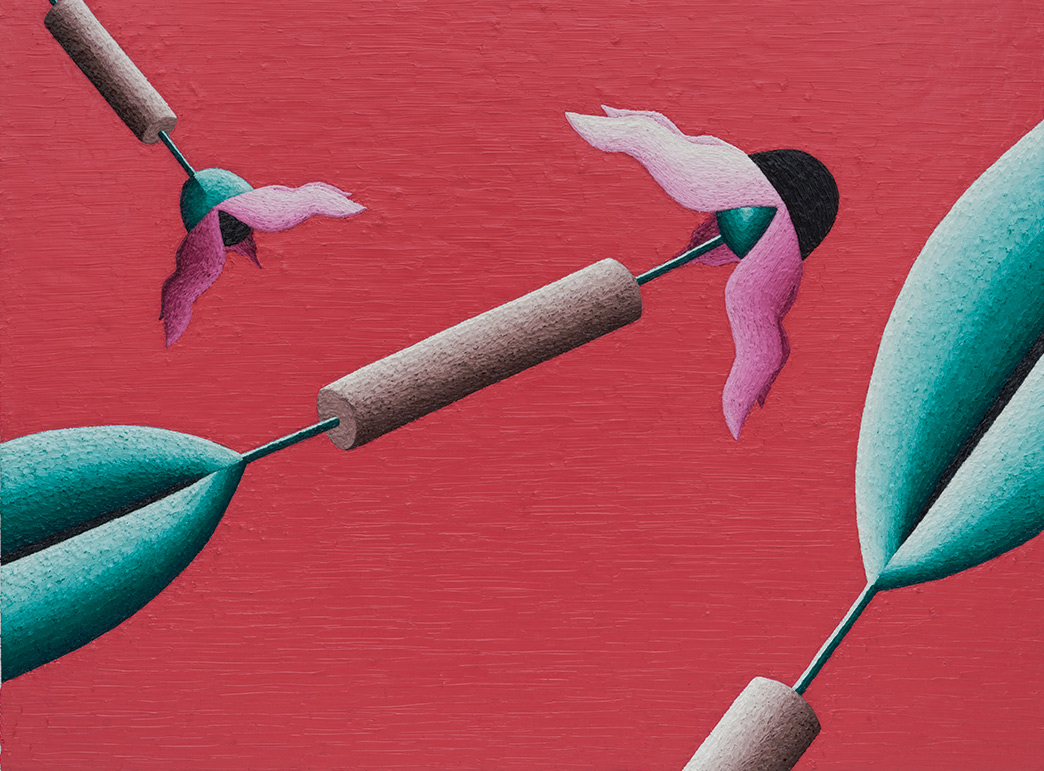
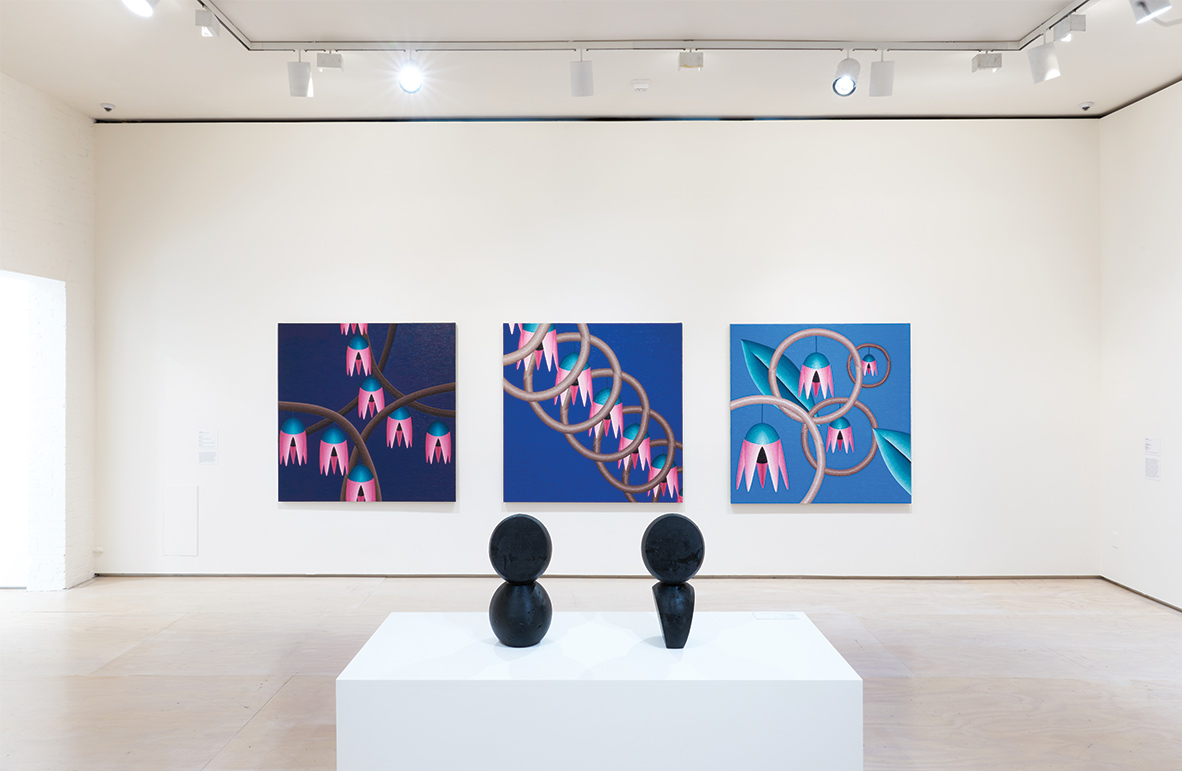
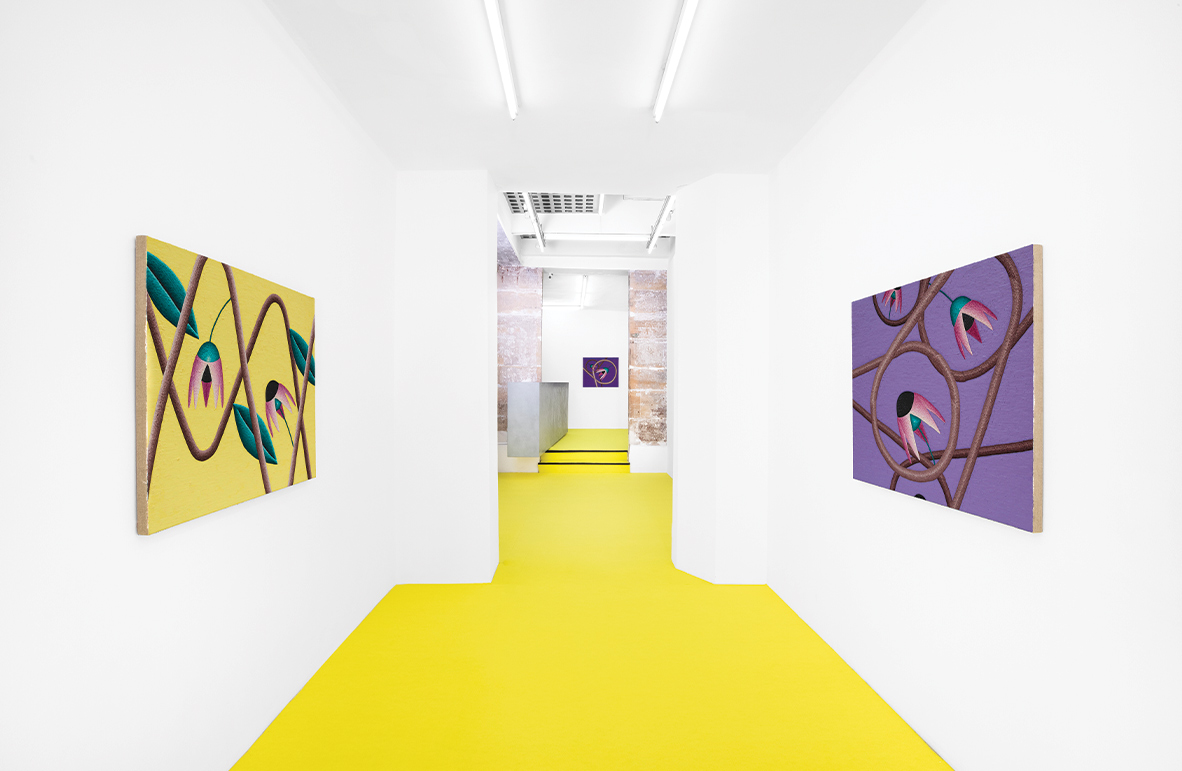
I think about them narratively; different arrangements of the three tell a story. With every new body of work I embark on, I consider changing the protagonists and start an active conversation with myself about what the forms can or can’t do in it. It’s a complex process that takes time; I paint the first layer of a painting, sit back and look at it for an extended period, and argue with it over the next couple of layers to find the composition that is the most compelling to me. After doing this with two or three smaller scale paintings, the rules of the specific body of work are established. Typically, this means the protagonists have gained new formal features such as a longer stem or a new lighting which gives them new narrative potential. In this sense, language and how I articulate things to myself becomes really important; it’s the means by which I continue to let my work change. This discursive process keeps the urgency of the paintings alive.
You return to the same forms repeatedly. Has repetition ever changed what these forms mean to you over time?
Yes, very much so. Coming back to invented forms that I know well has allowed me to layer their valences.
You’ve described color as something you feel physically. How do you know when a color is right?
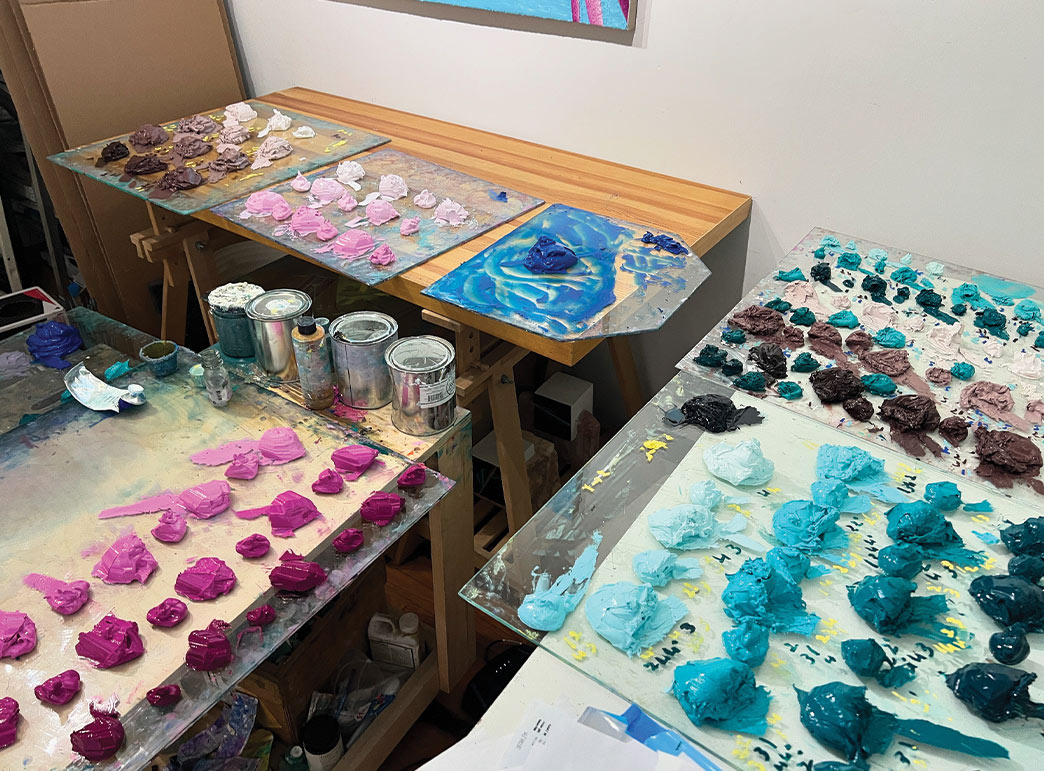
These days, I know a color is right when I sense that visual hum that a combination of tones can achieve. Take two colors I’m working with a lot these days: cadmium lemon and cobalt violet. These contrasting very intense colors can be calibrated by adding titanium white to to each, a little bit of cad lemon to the violet, and a little bit of cobalt violet to the yellow. This makes the yellow go a sharp neon leaning greenish yellow and the violet go a nice deep warm purple. When placed on the same surface they vibrate. I am looking for that eyeball singing feeling when I am establishing the palette of each work.
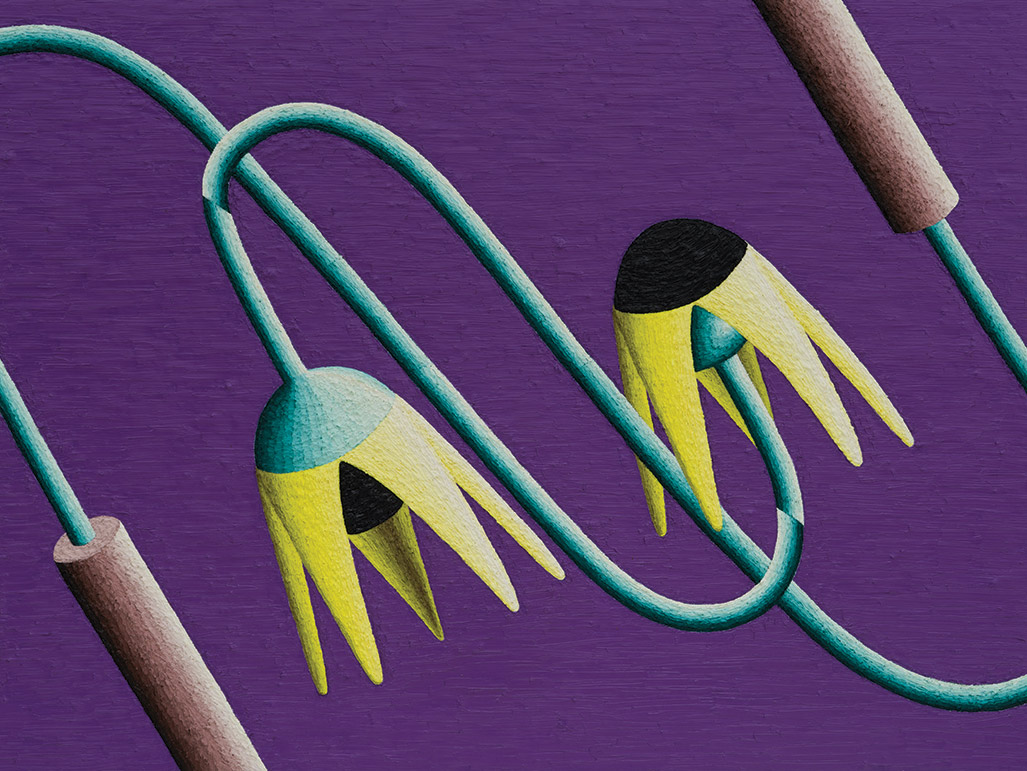
A single painting can take two to three months, building them up in thick layers of oil paint. What does that texture and slowness provide you?
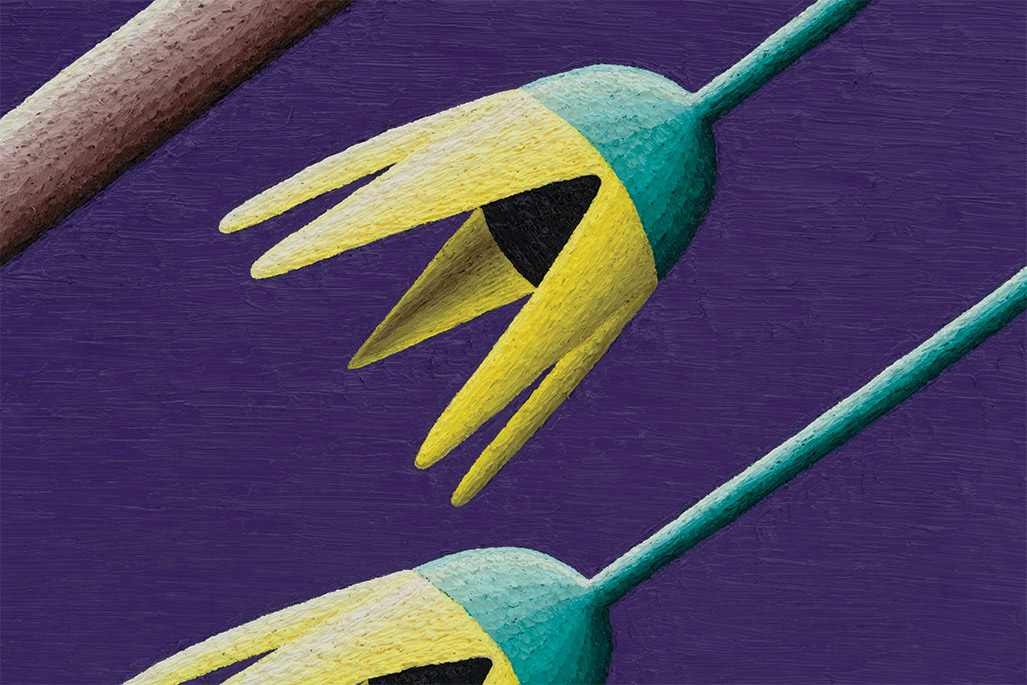
I begrudgingly see the time each painting takes as the price of the richness of the surfaces. The texture of the paintings is something I reflect on a lot as I obsessively and continuously refine the recipe (brush size, solvent type, etc). I’ve come to the conclusion that the reason I want the protagonists and the plastic space that surrounds them to have substantial skin is to engage the viewer on a physical level: to meet their bodies with a body of paint.
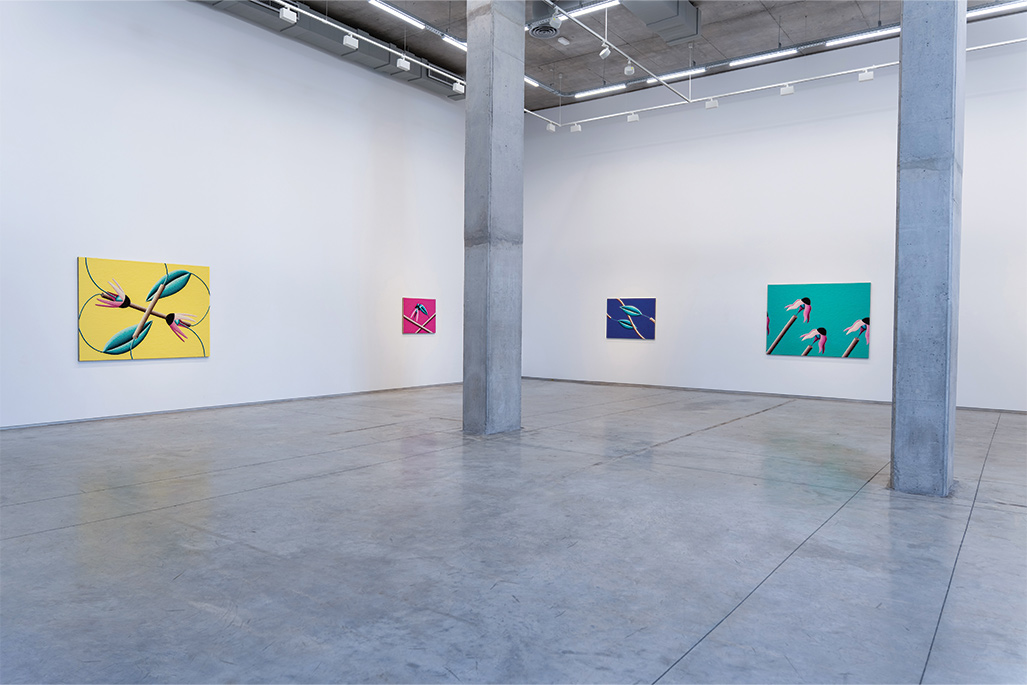
Oblivion Rains was your first solo show in Tunis, the city you left in 2000. What was it like to bring your work home?
Yes Oblivion Rains: Notations of Gravity, Light, and Resistance at Selma Feriani Gallery, curated by Fawz Kabra, was my first time showing in Tunis. Bringing the work to my hometown was very meaningful both personally and professionally. I felt so connected to that body of work; the pressure of showing in the place I grew up seemed to crystallize my process and I was sharper, more resolute as I made the work in my Brooklyn studio. Now many months later, I am still unpacking the impact of experiencing the palettes and characters I developed in the landscape of my childhood. It literally transformed my perception; it was as if a switch was hit and I could take in the incredible natural beauty of the city while having bandwidth to notice details I had never considered. I would think “Ooo right at that spot on the horizon is the blue I paint,” and “Oooooo right there in the young grass is the green I paint.” Some days during my trip, I would turn a corner in an area I had been many times before and the twirl of an olive tree against the bright blue sky would literally take my breath away.
The title comes from your phrase “big droplets of oblivion,” which painting pushes back against, and your work is often described as being about survival. What does painting help you resist?
In the initial months of making the works for the show, it felt like painting was buyoing me enough to not fall into apoplectic despair as the genocide of Palestinians was, as it is now, being streamed on our iphone screens. At the time, I recognized the seeming futility of art and often wished I was a doctor or something intrinsically useful. I accepted my uselessness by telling myself: “Well art is futile but by making it, I have a structure in these catastrophic days, and I can contribute as much as possible from my earnings.” Then, one afternoon in September of last year, I streamed the Together for Palestine concert at Wembley stadium and it cracked me open. The show centered Palestinian voices through music, poems and plays. For the length of the concert and many days after, I was jolted out of my dissociative state and I could take in even more of what was happening, I could feel more feelings; more pain; more everything. That cracking open taught me something: art is proof of life. Where life exists, so does art. That is its intrinsic value and a powerful threat to the oppressive structures that surround us. This has renewed my momentum in studio.
Is anything currently inspiring you?
There is a flock of pigeons that live on the roof of a building next to my local park (I live in a neighborhood where dozens of people keep pigeons on their roofs). Their keeper lets them out at high noon and they fly in low circles almost grazing the park’s trees. It’s one of the prettiest, most exciting parts of my day. I stand right below them alternating between looking up at their elegant flight and down at their frenetic shadows; for a few seconds of each of their ongoing loops, I feel like I might fly too.
Where can people find you?
I am showing a work with Selma Feriani Gallery at Frieze Abu Dhabi- it’s called Vortex II and is the largest work I’ve ever painted. I’m also @nadianejma on ig.